

Microscopic Resection of Intracranial Lesions with Tubular Retractor of Plastic Syringe
The Challenge-
Reaching tumors deep within the brain is one of the most difficult tasks in neurosurgery. Traditional metal retractors can apply uneven pressure, potentially causing brain bruising, seizures, or small hemorrhages (bleeding) during the procedure.
The Solution-
This study highlights a creative, cost-effective breakthrough: using a modified plastic syringe as a tubular retractor. By using a smooth Teflon introducer to gently slide the syringe into place, surgeons can create a stable, 360-degree “tunnel” to the tumor. This method protects the surrounding healthy brain tissue by distributing pressure evenly.
Quick Stats of 157 cases-
Success Rate: 85.35% achieved Gross Total Resection (complete tumor removal).
Average Blood Loss: Only 100 mL, showing the precision of the approach.
Safety Profile: Very low complication rates, with only 3.82% experiencing brain contusions.
Versatility: Successfully used for various deep lesions, including colloid cysts, meningiomas, and metastatic tumors.
The Verdict-
The “Syringe Port” is a safe, effective, and highly accessible alternative to expensive proprietary surgical tools, offering excellent patient outcomes with minimal surgical trauma.
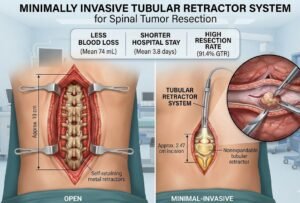
Microscopic Minimal Invasive Resection of Spinal Tumor with Tubular Retractor System
This study, published in the Asian Journal of Neurosurgery, co-authored by Dr. Dipanshu Narula demonstrates that minimally invasive surgery (MIS) using a microscopic tubular retractor system is a highly safe and effective alternative to traditional open surgery for resecting intradural spinal tumors. By utilizing a “keyhole” approach that preserves midline spinal structures and minimizes muscle trauma, researchers found that patients experienced significantly lower blood loss, shorter hospital stays (averaging 3.8 days), and excellent long-term neurological recovery. With a 91.4% gross total resection rate across 70 cases, the study concludes that this technique offers a superior, less-invasive solution for spinal tumor removal without compromising surgical precision or spinal stability.