
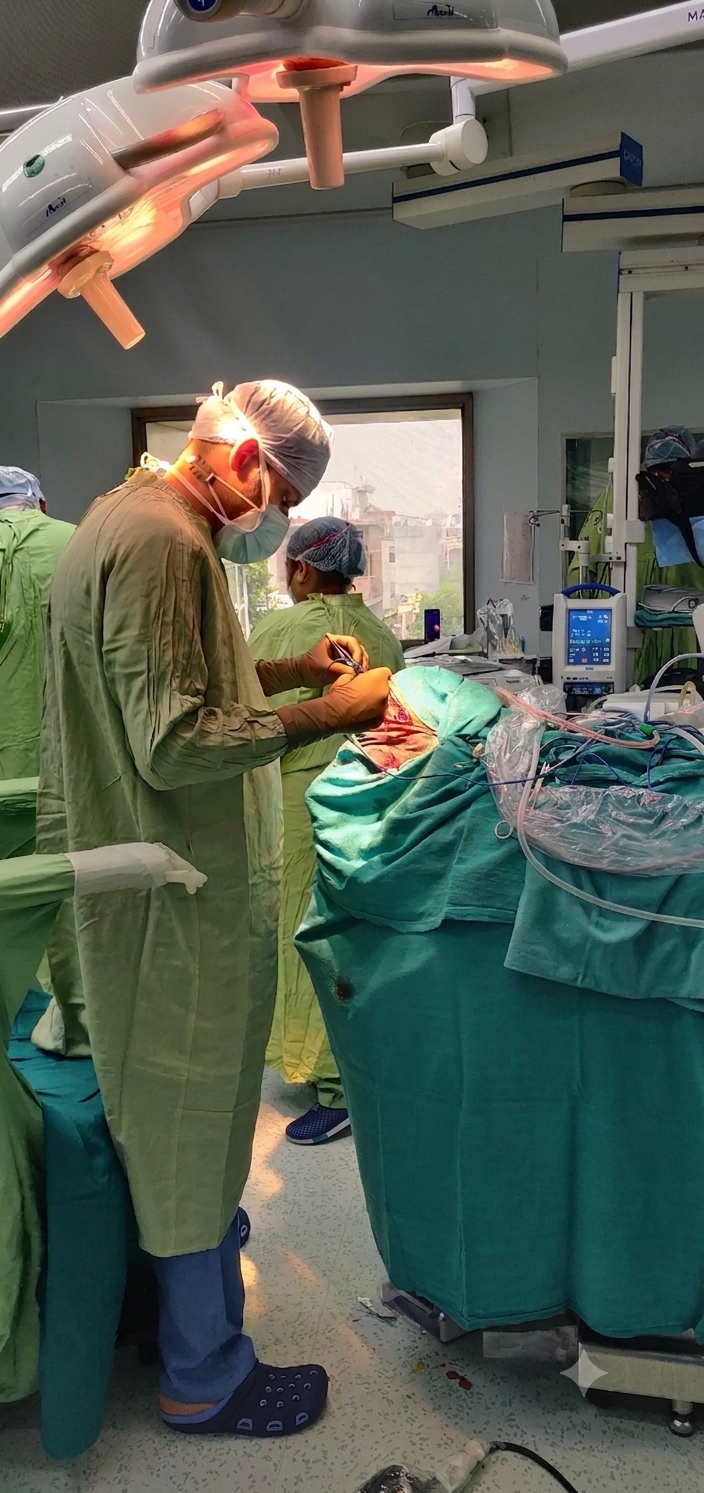
About Dr. Dipanshu Narula
Neurosurgery built around understanding, precision and trust.
For a patient, meeting a neurosurgeon often comes with fear. Dr. Narula's approach is to slow that moment down: explain the diagnosis clearly, separate urgent problems from manageable ones, and help the family understand every reasonable option before a decision is made.

A neurosurgeon, but first a doctor who listens.
Every diagnosis is personal. Two patients can have similar MRI findings and still need very different approaches because symptoms, age, medical history, neurological function and individual circumstances all matter.
Dr. Narula believes a consultation should go beyond simply looking at a scan. The goal is to replace uncertainty with understanding, so patients can participate meaningfully in decisions about their care.
Credential details stay verified
Exact dates, affiliations, recognitions and timelines should be added only after direct confirmation from the practice.
Education and specialised neurosurgical training.
Dr. Dipanshu Narula completed advanced neurosurgical training with a foundation in complex conditions involving the brain, spine and nervous system.
Areas of neurosurgical expertise.
Each area is approached through diagnosis, imaging, neurological function and the patient's overall clinical picture before treatment is discussed.
Brain & Spine Tumours
Surgical evaluation and management planned around imaging, neurological function and the tumour's relationship with critical structures.
Explore careMinimally Invasive Neurosurgery
Smaller-access techniques considered only when the condition, anatomy and treatment objective make them appropriate.
Explore careEndoscopic Neurosurgery
Camera-guided approaches for selected brain and spine conditions where endoscopy is clinically suitable.
Explore careNeurovascular Surgery
Assessment and planning for brain aneurysms and AVMs, with attention to surrounding brain structures and vessels.
Explore careEpilepsy Surgery
Surgical evaluation for selected patients whose epilepsy remains difficult to control despite appropriate medical treatment.
Explore careHead Injury Management
Neurosurgical assessment for head injuries based on severity, neurological status and imaging findings.
Explore careThe Neuro Saarthi approach.
A saarthi is someone who guides you through a difficult journey. In neurosurgery, that guidance matters because patients and families often make decisions while they are anxious or uncertain.
Listen
Symptoms, concerns, medical history, previous treatment and the patient's own experience start the consultation.
Understand
Reports and imaging are read in the context of the individual patient, not in isolation.
Explain
Medical terminology is translated into clear language so patients can understand diagnosis and options.
Decide
Treatment is recommended according to the patient's clinical circumstances, with surgery explained only where appropriate.
Surgery is not always the first answer.
The question is not simply whether a condition can be operated on. The more important question is whether surgery is appropriate for this patient, at this time, and for this particular condition.
Precision is more than surgical technique.
Precision also means understanding the diagnosis, identifying the treatment objective, planning the surgical approach, communicating risks and understanding what matters to the patient.
Brain, spine and nerve care for different neurological journeys.
Dr. Narula's clinical practice covers neurological conditions involving the brain, spine and nervous system in adults and children where neurosurgical care is appropriate.
Brain
Spine
Nerves
Children

Sometimes, clarity is the next treatment.
Being told that brain or spine surgery may be needed can be difficult to process. A second opinion can help patients understand whether surgery is necessary, how urgent it is, what the procedure involves and whether other options may be appropriate.
For adults and children
Neurological conditions can affect people at very different stages of life. Children may require a different approach to diagnosis, communication and treatment, and suitability is decided after individual assessment.
What patients can expect in consultation.
The consultation is designed around clarity, from symptoms and reports to treatment choices and the next step.
Understand symptoms
Symptoms, duration and effect on daily life are discussed carefully.
Review history
Previous diagnoses, medicines, treatments and relevant medical events are considered.
Review imaging
MRI, CT and other relevant investigations may be reviewed as part of assessment.
Compare opinions
Existing recommendations can be discussed to clarify context and decision-making.
Discuss options
Observation, medicines, further tests, surgery or other suitable approaches are explained.
Plan the next step
The consultation should leave the patient with a clearer way forward.
Why Neuro Saarthi?
The practice is built around specialised expertise, careful planning and a clear, patient-centred conversation before major decisions.
Expertise
Specialised neurosurgical training and clinical focus across complex brain, spine and neurological conditions.
Precision
Careful evaluation and treatment planning based on the individual patient.
Communication
Complex medical information explained in a way patients and families can understand.
Second Opinions
A space for patients who want to understand their options before a major decision.
Patient-Centred Care
The patient's condition, concerns and circumstances remain central to the consultation.
Appropriate Technology
Advanced techniques are considered where clinically appropriate and never for their own sake.
“Your diagnosis is important. But so is understanding it.”
A neurological diagnosis can bring fear, uncertainty and many questions. My role is to help you understand what is happening, what your options are and what may be appropriate for you.
Neurosurgery requires precision, but it also requires judgement, communication and trust. Sometimes the most important first step is not surgery. It is clarity.
You do not have to navigate a neurological diagnosis alone.
Whether you have just received a diagnosis, have been advised surgery, or want to understand your condition better, the next step can begin with a conversation.
Neuro Saarthi - Feeling Your Nerves
Bring your reports. Leave with clarity.
For brain, spine and nerve concerns, connect through a phone call or visit the clinic with MRI/CT reports and previous prescriptions.
+91 97723 48065
C-6, C Block, Sector 34, Noida